
Going over an old roof saves a day and hides everything
You can install a second layer of shingles over an existing one. Building codes in a lot of places allow up to two layers. Plenty of companies will quote it, it comes in cheaper, and it finishes faster. We do not do it, and the reason is not craftsmanship for its own sake. It is that roofing over means nobody ever looks at the deck.
The deck is the plywood or plank sheathing your entire roof is nailed to. It is the structural surface that everything else depends on, it is the part most likely to have deteriorated, and it is completely invisible unless the shingles come off. When a crew roofs over, they are nailing a new roof to a surface they have not seen and cannot vouch for, and neither can you.
What the deck tells you
Tear-off is the one moment in a roof’s life when the whole structure is visible at once, and it is remarkably informative.
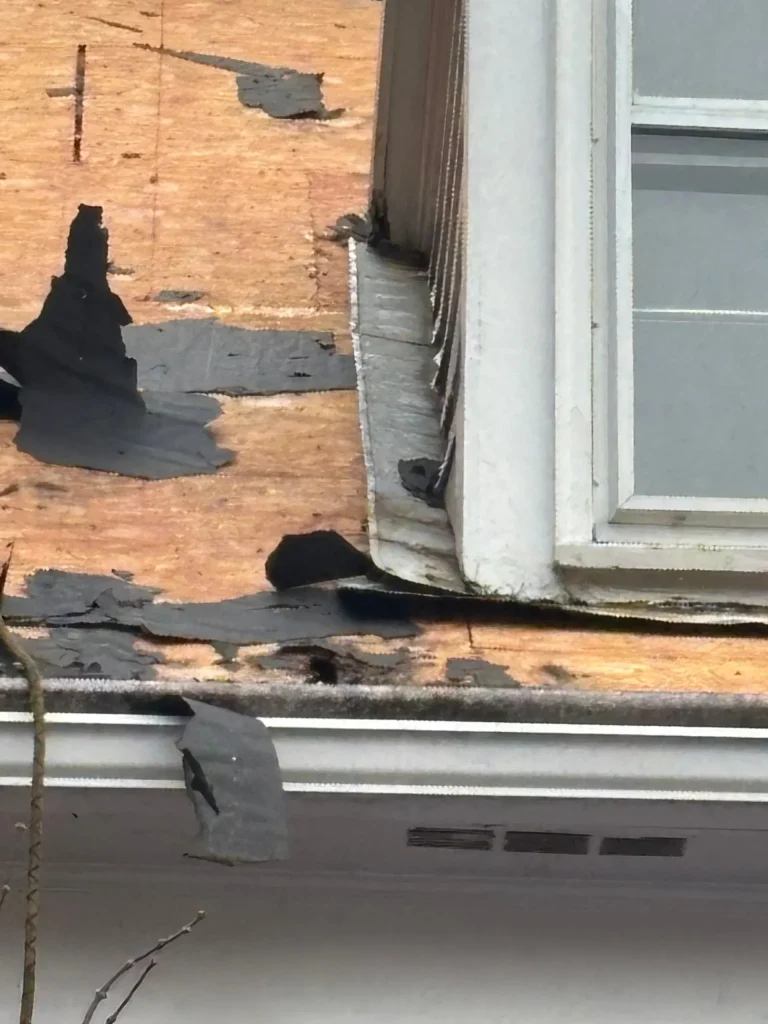
Soft spots are the obvious thing. Sheathing that has been wet repeatedly, usually near a valley, a chimney, a skylight or a wall intersection, loses strength and eventually will not hold a nail. You can find these by walking a torn-off deck in a way you absolutely cannot from on top of shingles.
Old leak paths are the more useful finding. Staining on the deck traces exactly where water has been getting in and how far it traveled, which often reveals a flashing detail that has been failing quietly for years. That is a problem you can now fix permanently instead of covering it with new shingles and waiting.
Nail patterns matter too. Sheathing that was under-nailed originally, or that has backed out over decades of thermal movement, needs re-nailing before anything goes over it. Lifted sheathing telegraphs through new shingles as visible waviness, and that is the cosmetic cost people notice on roof-overs.
You also learn about the framing. Rafters or trusses that have been cut for a bathroom vent, sagging between supports, or damaged by an old leak are all visible from above with the deck exposed.
Ventilation is the last thing, and it is the one most often wrong. Once we can see the whole assembly, we can tell whether intake at the soffits and exhaust at the ridge are actually in balance, or whether somebody added a ridge vent without ever opening the soffits, which produces a system that pulls conditioned air out of your house and cooks the shingles from underneath.
Why layering shortens the roof you just paid for
Beyond the inspection problem, a second layer of shingles performs worse than a first layer, for reasons that are physical rather than philosophical.
Heat is the main one. Asphalt shingles age by losing volatiles, and they lose them faster when they run hot. Two layers hold considerably more heat than one because the lower layer insulates the upper from the deck, which in our climate matters a great deal. Georgia summers do more damage to a roof than any winter here does, and a layered roof runs hotter through all of it.
Weight is the second. Shingles are not light and doubling them is real added load on a structure that was designed for one layer plus a safety margin.
Then there is the flat-surface problem. Shingles are designed to lie on a plane. Laid over an existing course, every new shingle bridges the bump of the one below it, so it never seats flat and the nails do not seat consistently. That is how you get a roof that looks slightly rippled from the street and loses shingles in a wind event that the neighbors’ roofs survive.
And when it eventually fails, the tear-off is now twice the work and twice the disposal, so the money saved comes back with interest.
What a proper replacement actually involves
Everything comes off, down to the bare deck, with the property protected first. That means covering the landscaping, protecting anything below the eaves, and magnet-sweeping for nails at the end.
The deck gets inspected. Soft sections come out and get replaced with sheathing of matching thickness, and loose sheathing gets re-nailed. This is also when we photograph what we find, so you can see the condition of your own roof rather than taking our word for it.
Then the water management layers, in order, because the sequence matters as much as the materials. Ice and water membrane at the eaves and in every valley, because those are where water concentrates and where wind-driven rain gets pushed backward. Underlayment across the field. Drip edge in the correct relationship to the underlayment, which is at the eave under and at the rake over, and getting that backwards means water running behind the fascia where nobody sees it until the soffit fails.
New flashing everywhere, not reused flashing. Step flashing at every wall intersection, new counterflashing at the chimney, new boots on every pipe penetration. Pipe boots are the single most common source of roof leaks we get called to, because the rubber collar cracks with age while the roof around it is still perfectly sound.
Then ventilation designed rather than assumed, with intake and exhaust in balance, and shingles last. Our roof replacement work follows this sequence every time, and the deck photos are part of what you get.
Reusing old flashing is the quiet version of the same mistake
Even on a tear-off, there is a shortcut available: leave the existing step flashing in place and shingle around it. It saves cutting into the siding and it saves time.
Step flashing is the cheapest material on the entire job and the most common cause of a wall leak afterward. It is bent metal that has been through decades of thermal cycling, is frequently corroded at the fasteners, and was sized for the old shingle course. Reusing it on a roof that is meant to last decades is a strange economy.
The same goes for chimney counterflashing that has pulled loose from its mortar joint, and for a skylight that is being reflashed with the old kit. If it is coming off anyway, it gets replaced.
When a repair is the right answer
Not every roof needs replacing, and we say so. If the field of the roof still has life in it and the problem is a specific detail, repairing that detail is the correct and honest answer.
Most leaks are at penetrations and transitions rather than out in the open field. A cracked pipe boot, step flashing that was never installed properly at a wall, a valley packed with debris, chimney counterflashing that has come away. Those are all fixable without touching the rest of the roof.
What we will not do is smear roofing cement over a suspected leak and call it done. That buys a season, makes the eventual proper repair harder, and often ends up in the wrong place anyway, because water travels. A stain on a ceiling can be several feet downslope from where the water actually entered, so the repair starts with tracing it rather than treating the nearest suspect. Our roof repair work starts at the entry point, not the symptom.
The dividing line is the deck. When the sheathing under the shingles has gone soft, a patch is a temporary measure on a larger problem, and we would rather tell you that than take money for it.
What Georgia weather does
Heat and humidity age asphalt faster than cold does. A roof here is under thermal load for a long stretch of the year, and attic temperatures on an under-ventilated roof get high enough to shorten shingle life measurably from the underside.
Summer storms are the other factor, and they find every weak detail. Wind-driven rain moves water sideways and uphill in a way ordinary rain does not, which is exactly why the eave and valley membrane matters and why a roof can be fine for years and then leak in one specific storm.
Tree cover is the third, and much of the north metro has plenty. Debris in valleys holds moisture against the roof, and overhanging limbs abrade the surface every time the wind blows.
The ventilation problem nobody mentions
A roof is a system that includes the attic under it, and most of the roofs we tear off have a ventilation setup that does not work. The principle is simple: cool air enters low at the soffits, moves up the underside of the deck, and leaves at the ridge. That flow carries heat and moisture out.
Where it goes wrong is almost always intake. Somebody installs a ridge vent, which is visible and easy, and never verifies that the soffits are actually open. Blocked soffits are common, sometimes because insulation was blown in and pushed against the underside of the deck, sealing the path. Now the exhaust has nowhere to draw from except the house itself, so it pulls conditioned air up through every ceiling gap, which costs you money in both seasons and dumps humid indoor air into the attic in winter.
Mixing exhaust types causes the other version. A ridge vent plus powered fans plus gable vents means the system short-circuits, drawing air from the nearest opening instead of from the soffits, so the far end of the attic gets no flow at all. More vents is not better ventilation. Balanced vents are.
Questions about roof work
How do I know if my decking is bad before you start?
You do not, and neither do we with certainty. That is the entire argument for tearing off. There are indirect signs, like visible sagging between rafters or a spongy feel underfoot, but a deck can be significantly compromised in localized areas with nothing visible from outside.
Is a second layer ever acceptable?
It is legal in many jurisdictions and it is sometimes what a budget allows on a property somebody is about to sell. We understand the arithmetic. We just will not be the ones to install it, because we would be putting our name on an assembly we have not seen.
How long does a replacement take?
A typical residential roof is a small number of days depending on size, complexity and weather, with tear-off and dry-in usually happening the same day so the house is never open overnight.
Will you show me the deck?
Yes, and we would rather you looked. Photos at minimum, and in person if you are home. It is the one chance anyone gets to see the structure of their own roof.
If your roof is on your mind
The useful signals are granules accumulating in the gutters, shingles that are curling or missing, any staining on an upstairs ceiling, and daylight visible in the attic. Any of those is worth a look.
Call (678) 665-7771 or reach us through the contact page and we will come out and tell you what you are actually looking at, including when the answer is that you have years left. We work across the north metro, including Acworth and Canton, where mature tree cover keeps valleys and flashing details busy.