

Tile
Tile that stays flat and tight in Johns Creek houses
When tile cracks or a grout line keeps opening, the cause is almost always underneath it. In a Johns Creek house built around the turn of the century, the usual suspects are a floor that flexes over a long span or a shower wall built on the wrong board. We fix the base first, then lay the tile to a plan.
Why tile fails in a house this age
Tile and grout are rigid. They do not bend with a floor, so when the floor moves, they crack. Houses from the late nineties and two-thousands are mostly framed with wood joists under plywood or OSB, and over a long span a floor like that can flex enough to break a large tile while the house itself stays perfectly sound.

Before we lay anything, we check the floor for bounce and for flatness. Where it bounces, we stiffen it with blocking between the joists or a second layer of subfloor. Where it is out of flat, we level it. Then an uncoupling membrane or cement backer board goes over the subfloor as the layer the tile actually bonds to, chosen for the tile and the room.
Wet areas are their own question. Cement board is fine behind shower tile when a membrane goes over it. Foam board is waterproof in itself once its seams are sealed, and it weighs less, which helps on a wall with a niche and a bench. Plain drywall has no business in a shower, even the moisture-resistant kind. Our tile installation page covers the service in general terms.
Layout comes before the first piece
The difference between a tile job that looks right and one that looks slightly off is mostly decided with a pencil and a chalk line.
Find the centerlines
We snap lines off the room’s real center and the wall you see first when you walk in, then dry-lay a row each way. The goal is to keep full tiles where the eye lands and push cut pieces to the edges, under a vanity or along a toe kick.
Avoid the sliver
If the layout leaves a strip an inch wide against one wall, we shift the whole grid so both sides get a reasonable cut. Doorways get the same attention, because that is where a thin cut shows most.
Control lippage on large format
Big porcelain tiles carry a slight bow from the kiln, and a floor that is a little out of flat makes their edges sit at different heights. We flatten the floor to suit the tile size and keep the offset on long planks within what the manufacturer allows. A leveling system holds each edge in plane while the thinset cures.
None of this shows in a finished photo, which is why it gets skipped. It shows in person, at an angle, with the afternoon light across the floor.
Small tile on a shower floor, big tile everywhere else
Large-format porcelain is what most people want on a bathroom or kitchen floor now. It means fewer grout lines and suits the bigger rooms in these houses. It does not suit a traditional shower floor. A floor that slopes to a center drain falls in four directions, and a flat, rigid tile cannot follow that shape without rocking or cracking.
That is why shower floors get mosaic, penny tile or small hex. The small pieces follow the slope, and the extra grout gives your feet some grip when the floor is wet. If you want the floor to match the room, a linear drain lets the shower floor fall one way, so a larger tile can work there too. We can also carry one tile up the walls and keep the mosaic underfoot.
Where tile meets a wall, a tub or another plane, and across long runs of floor, the joint gets a flexible sealant instead of grout so the movement has somewhere to go. Hard grout in a corner is the crack that shows up down the road.
Showers and the details that line up
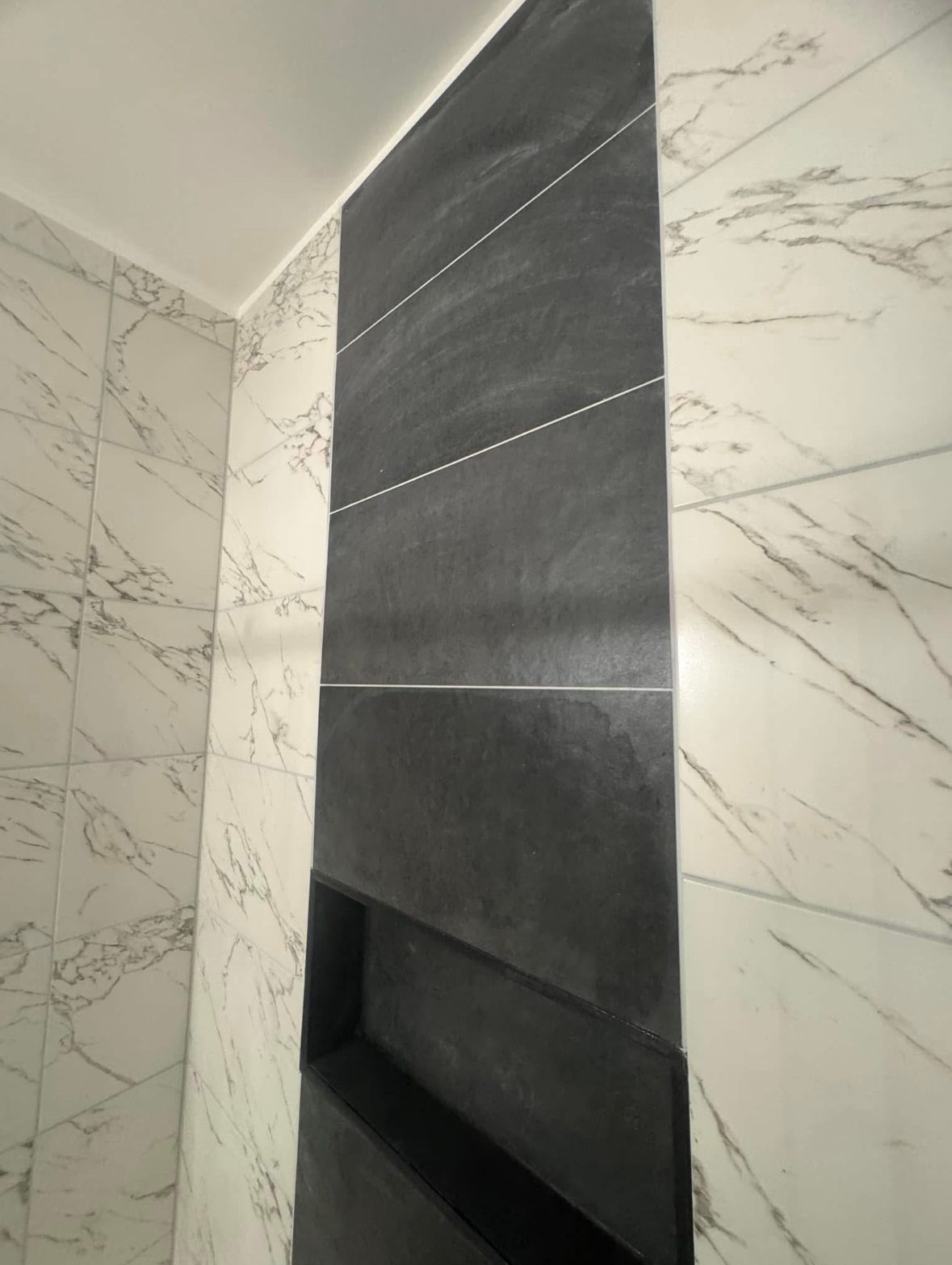
In a shower, everything has to agree: the niche, the bench, the valve, the accent band and the grout lines. The photo here is one of ours, a vertical stripe of charcoal large-format tile running through white marble-look porcelain, with the niche set into the stripe and lined up with it. That alignment gets decided when the walls are framed. By the time the tiler reaches the niche, it is too late to move it.
Behind that tile is a waterproof wall. If you want to see what happens before tile goes on, our walk-in shower page for Johns Creek goes through the membrane, the bench and the niche. Accent stripes, niches and mosaic floors all add cuts and time, and we will tell you plainly which ones are worth it in your room.
Plain walls are fine too. A simple shower in one tile, set flat with tight joints and a niche that lands on a grout line, reads well for a long time.
Backsplashes behind counters you are keeping
A new backsplash is one of the smaller tile jobs we do. Sometimes the counters are still good and only the backsplash looks dated. We pull the old one without damaging the counter edge, patch and flatten the wall, and plan the layout off the window and the range so the cuts are even on both sides. Outlets get box extenders so the covers sit flush on the new surface.
Johns Creek is in Fulton County, same as our Roswell shop, and well within the area we work. The rest of what we do there is on our Johns Creek page. Igor Dubovoy started the company in 2021, after two decades in the trade, and he still runs jobs from the site. Tile is where that shows, because the decisions about where cuts land get made in the room, with the tile in hand.
Finished floors, showers and backsplashes are in the gallery. If you have tile picked out already, or just a room that bothers you, get in touch or call (678) 665-7771.
Where this is
Questions people ask before the tile arrives
Can you tile over our existing tile floor?
Sometimes, but we rarely recommend it. It adds height at doorways and appliances, and if the old tile is loose or cracked, the new floor inherits the problem. In most cases removing it lets us see and fix the subfloor, which is where tile trouble usually starts.
Why did the tile in our kitchen crack along a line?
A straight crack running across several tiles usually follows something underneath: a joist, a subfloor seam, or a crack in a slab. The tile is only reporting movement below it. We find the cause before replacing anything, or the new tile cracks in the same place. Sometimes that means stiffening the floor; sometimes it means a membrane.
How big can the tile be on our floor?
That depends on how flat the floor is and how much it flexes. Large-format porcelain needs a flatter base than standard tile, so bigger pieces can mean more prep. We check the floor at the walkthrough and tell you what size it can take as is and what it would need for larger.
Should the backsplash go all the way to the ceiling?
On a wall with no upper cabinets, such as behind a range hood, running it to the ceiling often looks finished. Elsewhere it usually stops at the underside of the uppers. Either way, we plan where the top edge and the side edges stop before buying tile, so the order covers the cuts.
Why is there caulk in some corners instead of grout?
Those are movement joints. Tile expands and contracts slightly, and the house moves with the seasons. Where two surfaces meet, a flexible sealant matched to the grout color lets that happen without cracking. It is part of the installation, and the sealant in a shower corner is worth checking every so often.
We already bought our tile. Can you install it?
Usually, yes. Bring us in before it is delivered if you can, so we can check the box quantities against the layout and look at the tile for size variation and bow. A few tile lines are fussy to set, and we would rather tell you that before demolition.
Show Igor the floor that keeps cracking
Igor will come out, look at the tile you have or the room you want tiled, and check what is under it before talking about finishes. The walkthrough is free, with no obligation after. Call (678) 665-7771 or use the contact page and we will set a time that works for you.