
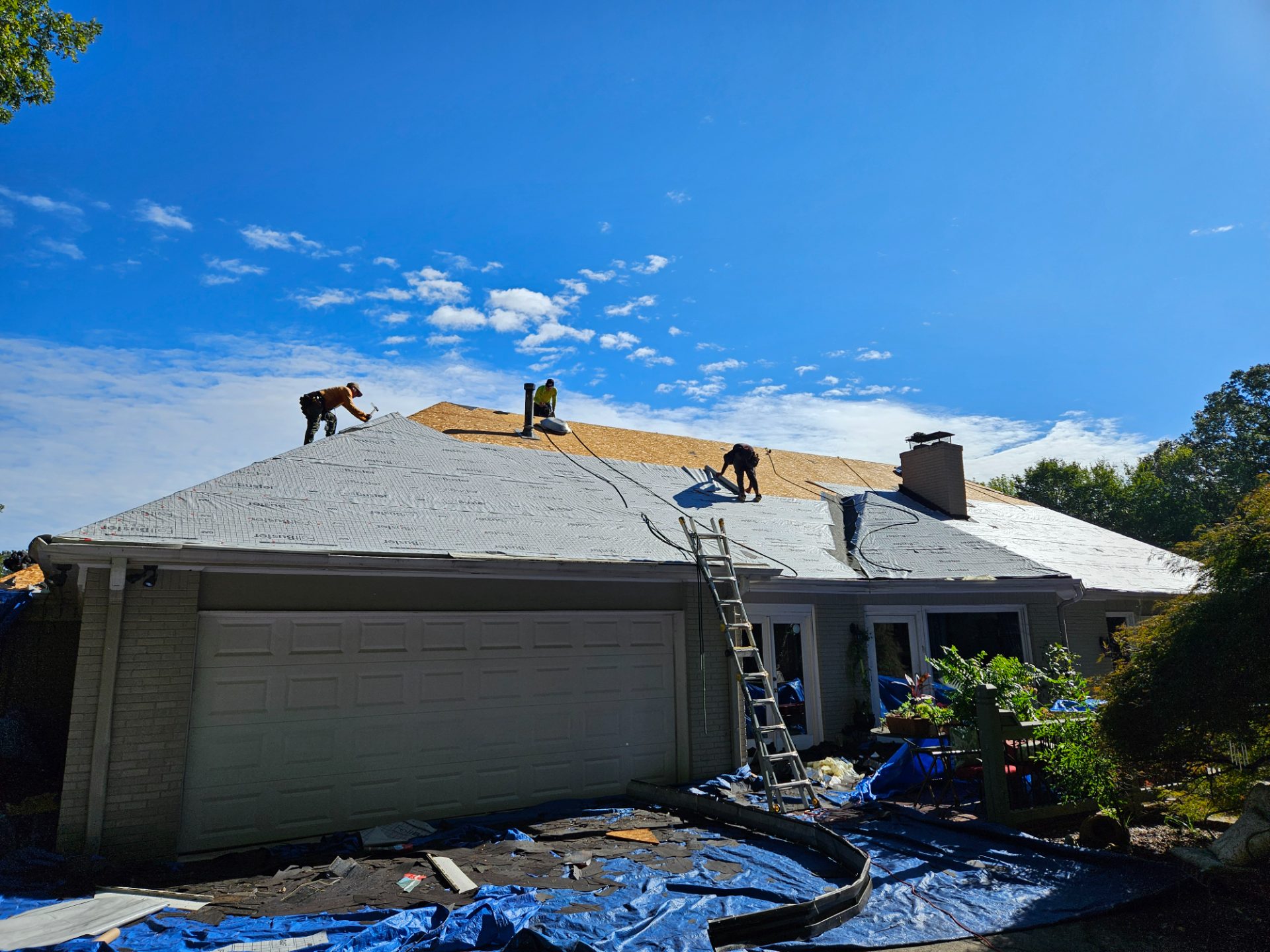
Roofing
Johns Creek roofs, torn off to the deck and rebuilt
We strip the old roof down to the wood, fix whatever decking has gone soft and replace the flashing at every wall instead of reusing it. On a Johns Creek house still wearing the roof it was built with in the late nineties or early two-thousands, that conversation is usually close.
When the original roof comes due
A roof that went on when the house was built in the late nineties has been through a lot of Georgia summers by now. The signs usually show from the yard before they show on a ceiling: shingle edges curling up, granules collecting at the bottom of the downspouts, and creased or missing tabs after a windstorm. Inside, the first stain tends to appear near a bathroom vent pipe or on the wall below a dormer.

Houses in Johns Creek tend to be big, and so are their roofs. Two-story walls, dormers and valleys meeting at odd angles add up to a lot of places where shingle meets something else. Those intersections are where water gets in, far more often than through the open field of shingles. If you are not sure whether yours is due, that is a fair question for the walkthrough, and sometimes the answer is a repair.
Our general approach is on the roof replacement page. This one is about how it goes on the houses we see around Johns Creek, which sits well inside our working radius from Roswell.
How the days go at your house
A roof replacement is loud and messy for a short stretch, and most of the mess lands in the yard. Here is how we keep it contained.
Before the first shingle comes off
Tarps go down over the beds, shrubs and the walk along the house, and plywood leans against any window or AC unit below the roof edge. We ask you to move cars out of the driveway the night before, since the dumpster needs the room.
One slope open at a time
We tear off only what we can dry in the same day. If afternoon storms build, which they do here in summer, that section is already covered in underlayment before the rain arrives. The house is never left open overnight.
A magnet over the whole yard
Roofing nails end up in the grass no matter how careful the crew is. At the end of each day, and again after the last shingle, we run a rolling magnet over the lawn and the driveway, then pull the tarps and haul everything away.
When the job needs a permit, it is ours to pull, and the final inspection is ours to schedule and attend.

What the tear-off uncovers
We take every layer off, down to the decking, and we never lay a new roof over an old one. A second layer hides the wood and leaves the old flashing buried under new shingles, where nobody can reach it again.
Once the deck is bare, we walk it. Sheathing that has soaked up water feels spongy underfoot and looks dark and delaminated. It shows up most often along the eaves, where gutters overflowed for years, and around dormers, where the sidewall flashing gave out first. Shingles nailed over a soft sheet never hold their nails well. Bad sheets get cut out and replaced with new ones nailed to the rafters, and you see photos of each spot before it gets covered.
The photo here is a dormer sidewall on the day of a tear-off. The old step flashing is still against the wall, and pieces of the old shingles remain in place. That metal comes out next. Reusing it saves a little time and puts the most leak-prone joint on the roof back into service with old, bent pieces.
Everything that goes on before the shingles
Most of a new roof is installed before a single shingle goes up. After the decking is sound, synthetic underlayment covers the whole roof. It lies flatter than the old felt and holds up better when someone walks on it, which matters on a steep two-story slope.
In the valleys and around every pipe, vent and skylight, we put down self-adhered ice-and-water membrane first. It seals around the nails driven through it, so the spots where water collects or slows down get a second line of defense under the shingles.
Then comes the metal. Step flashing is woven in with each course where the roof runs into a sidewall, with counterflashing over it where the wall is brick. Drip edge goes along the eaves and rakes. Every rubber vent boot is new, because the rubber collar on the old ones has usually cracked by the time the shingles are done.
We also look at ventilation while the roof is open. A hot, stale attic cooks shingles from below, so we check that the soffit intake is clear and that the ridge or box vents can actually move air out.
Picking shingles you can live with
Most replacements go back in architectural asphalt shingles, and the color decision takes longer than people expect. A large roof is a big share of what you see from the street, so we bring full-size samples and hold them against your brick or siding in daylight.
If your house is in a planned neighborhood, check whether it has rules about roof color or material before we order anything. We are happy to look over the paperwork with you, but the approval itself has to come from the association. Better to know that before the dumpster arrives.
Igor founded SSRGA in 2021, twenty years into the trade, and roofs get the same treatment as everything else we do. The people who tear off your roof are the people who shingle it, and we keep only a few jobs going at once so nobody is pulled off yours halfway through. Look through the gallery for more of our work, then reach us on the contact page or at (678) 665-7771 to set up a walkthrough.
Where this is
Roof replacement questions from Johns Creek
Do you ever install a new roof over the old one?
No. We tear off to the decking on every job. A second layer hides rotten sheathing and keeps the old flashing in service. Two layers also add weight the roof framing has to carry. And it makes the next replacement harder for whoever owns the house then.
How do I know whether the roof needs replacing or a repair?
Curling or cracked shingles across whole slopes, heavy granule loss and soft spots in the deck point to replacement. A single leak at a pipe boot or one patch of storm damage usually points to a repair. Igor will tell you which one he sees, and he has no reason to sell you the bigger job.
What happens if you find rotten decking?
We photograph it and send you the pictures the same day, then cut out the bad sheets and nail in new ones before any underlayment goes down. You will know how much was replaced and where. Nothing goes back over soft wood. We talk through that possibility at the walkthrough, so finding some is never a surprise.
Do I need to be home while the roof is replaced?
No, though most people are. Plan on noise all day while the tear-off is happening, and keep pets and kids clear of the side of the house we are working on. We need the driveway clear and the gate unlocked, and we check in with you before we leave each day.
Does a roof replacement need a permit?
We find out before the job is scheduled. Requirements differ between cities and counties, and when a permit applies we pull it and book the inspection ourselves. If the inspector wants something changed, that is on us too. You do not need to call anyone at the city.
Is there anything we should do once the new roof is on?
Keep the gutters clean so water leaves the eaves, and trim back branches that rub the shingles. After a big storm, a look from the yard with binoculars is enough. If you spot a lifted tab or a stain on a ceiling, call us and we will come out.
Replace now, or repair and wait?
Igor will walk the outside of the house with you, go up in the attic to look at the underside of the decking and the ventilation, and tell you whether you are looking at a replacement now or a repair that buys time. The walkthrough is free and there is no pressure to decide that day. Call (678) 665-7771 or write to us through the contact page.